← All our cities🇪🇸 Spain
Living in Alicante
Thirty-seven rainy days a year, and five months of sea above twenty-two degrees.
Thirty-seven rainy days a year, and five months of sea above twenty-two degrees.
The city sits between a rock and the sea. Mount Benacantil rises a hundred and sixty-six metres above the rooftops, the castle is at the top, the beach is at the bottom, and two lifts cut into the rock connect the two.
What you notice after a month is not the sun, it is that it does not rain. Thirty-seven rainy days a year: the terraces never bring the chairs in, and life happens outdoors most of the year.
The sea in Alicante reaches twenty-seven degrees in August and stays above twenty-two from June to October. The tram leaves from the centre and serves the coast for tens of kilometres: the beach is not a weekend, it is the end of a working day.
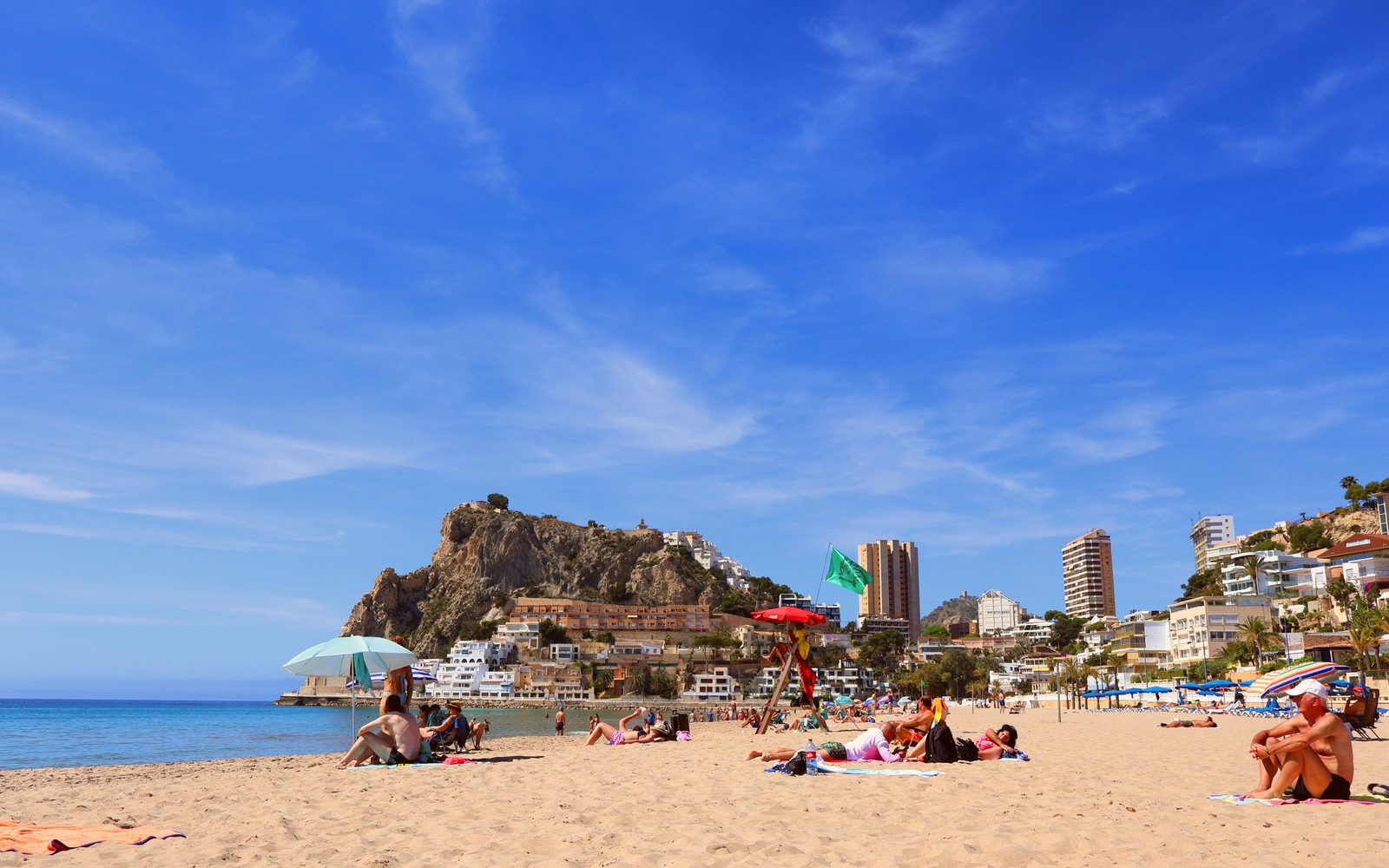
Nine hundred metres of golden sand in the middle of town, right under the castle rock. You walk down after work without taking a single form of transport. Blue Flag.
Nearly three kilometres of fine sand, eighty-five metres wide, with no slope. The city's big beach, served by three tram lines. Blue Flag, accessible, smoke-free.
Five Blue Flag beaches, and two thousand four hundred and seventy hectares of protected salt marshes where flamingos nest. It is also the port the boats to Tabarca leave from.
One thousand eight hundred and fifty metres long, four hundred and fifty wide, and one thousand seven hundred and fifty-four hectares of water designated a marine reserve in 1986. The first in Spain, four years ahead of the next.
One in four residents of the province is a foreign national, the highest share of the country's fifty-two provinces, and more than half of them are European.
InterNations Expat City Ranking, fifty-three cities scored by expats themselves: Alicante is third overall, second for quality of life and second for healthcare.
France is 99th. The Spanish homicide rate is 44 % below the French one and 49 % below the Belgian one.
The European Union Intellectual Property Office employs around eleven hundred professionals in Alicante, works in five languages and takes filings in twenty-three.
Alicante has 2,851 hours of sunshine a year, against 1,660 in Paris. But the number that changes daily life is elsewhere: thirty-seven rainy days a year, against a hundred and ten in Paris and a hundred and thirty-three in Amsterdam. Three times fewer. And in January the afternoon still climbs to seventeen degrees.
| Sunshine a year | Rainy days | January, average high | July, average high | |
|---|---|---|---|---|
| Alicante | 2,851 h | 37 d | 17.0 °C | 30.3 °C |
| Amsterdam | 1,780 h | 133 d | 6.2 °C | 22.5 °C |
| Berlin | 1,730 h | 101 d | 3.2 °C | 25.0 °C |
| Brussels | 1,605 h | 131 d | 6.3 °C | 23.5 °C |
| Paris | 1,660 h | 110 d | 7.6 °C | 26.3 °C |
And the sea follows: 27.1 °C in August, 25.7 °C in September, still 22.9 °C in October. Five months of swimming above twenty-two degrees, from June to October.
The airport is about ten kilometres from the centre. There is no tram and no train to it: it is bus line C-6, €3.85, twenty-five to thirty-five minutes, one departure every twenty to forty minutes.
Frequencies recorded in July 2026, outbound only. Forty airlines serve Alicante.
Real prices, not the ones on the tourist streets.
The €7.50 fare covers ages 15 to 30, and under-14s travel free. This is not a seasonal promotion: the Spanish state subsidies on public transport run through the whole of 2026.
It depends on the role, the language and the employer, and a good share of our roles also come with help towards accommodation and the cost of getting there. Your recruiter gives you the exact detail, package included, before you commit to anything.
The price shown is the asking rent per square metre in the district, recorded in May 2026. The city average is €13.2 per square metre, and a room in a flatshare goes for €300 to €420 depending on the area.
The district around Plaza de los Luceros, ground zero of the tram and bus network. Large 1970s flats, often 120 to 150 square metres: the best flatsharing ground in the city, and the cost per person drops fast. Central, and still cheaper than the traditional centre.
🚇 Plaza de los Luceros · every tram lineWorking-class residential, the most Valencian-speaking district in Alicante and the most involved in the Hogueras since 1929. Narrow streets, local shops, no tourists. The cheapest genuinely central area in the city. Built in the 1960s: check for a lift before you sign.
🚇 North of the centre · on footA working-class district laid out in 1883 on hygienist principles: wide, tree-lined streets around a square, with its own market, theatre and church. It is also the fastest-rising district in the city, which means its price advantage narrows every year.
🚇 Near the station · 10 min from the centreBorn in 1858 with the arrival of the railway, originally housing for rail workers. A working-class district with a strong identity, where the city's rappers grew up. Central, alive, and among the cheapest.
🚇 10 min on foot from the centreThe most populated district in the city, 2000s buildings, a pedestrian promenade along nearly three kilometres of sand. The population here is younger than elsewhere. Count half an hour by tram to reach the centre, and a much quieter district in winter.
🚇 Tram L4 · 27 min from LucerosCabo de las Huertas and Casco Histórico-Santa Cruz are the two most expensive areas: private villas and gated developments on one side, postcard scenery on the other. Neither makes a good first home.
Two lifts cut into Mount Benacantil climb a hundred and forty-two metres, at the end of a two hundred and five metre tunnel that starts straight off Postiguet beach. They date from 1963, the year the castle opened to the public.
Tabarca, offshore, is the oldest marine reserve in Spain: designated in 1986, four years before the next one. It is also the only inhabited island in the Valencian Community, settled in 1768 by three hundred and twenty-three Ligurians whom Charles III had freed from the Tunisian island of Tabarka. The Genoese surnames are still there.
The wave-patterned paving of the Explanada de España, in red, ivory and black marble, was designed in the 1950s after the mayor and his architect travelled to Lisbon. It is directly modelled on the paving of the Rossio.
Salary shown upfront, a signed job offer before you fly, and the local language is never required.
Fifteen minutes on the phone with a recruiter who lives there. We go through the open roles, the package and the timing.
Hiring multilingual talent? We cover the European markets. ★ 5.0 · 132 Google reviews What we do for you →
Measurement and attribution
With your consent, we keep for 90 days a record of the campaign that brought you here, so we know what works. Our audience measurement is anonymous and needs no consent. You can change your choice at any time. Privacy policy