← All our cities🇵🇹 Portugal
Living in Lisbon
The westernmost capital on the continent, and the sunniest in Western Europe.
The westernmost capital on the continent, and the sunniest in Western Europe.
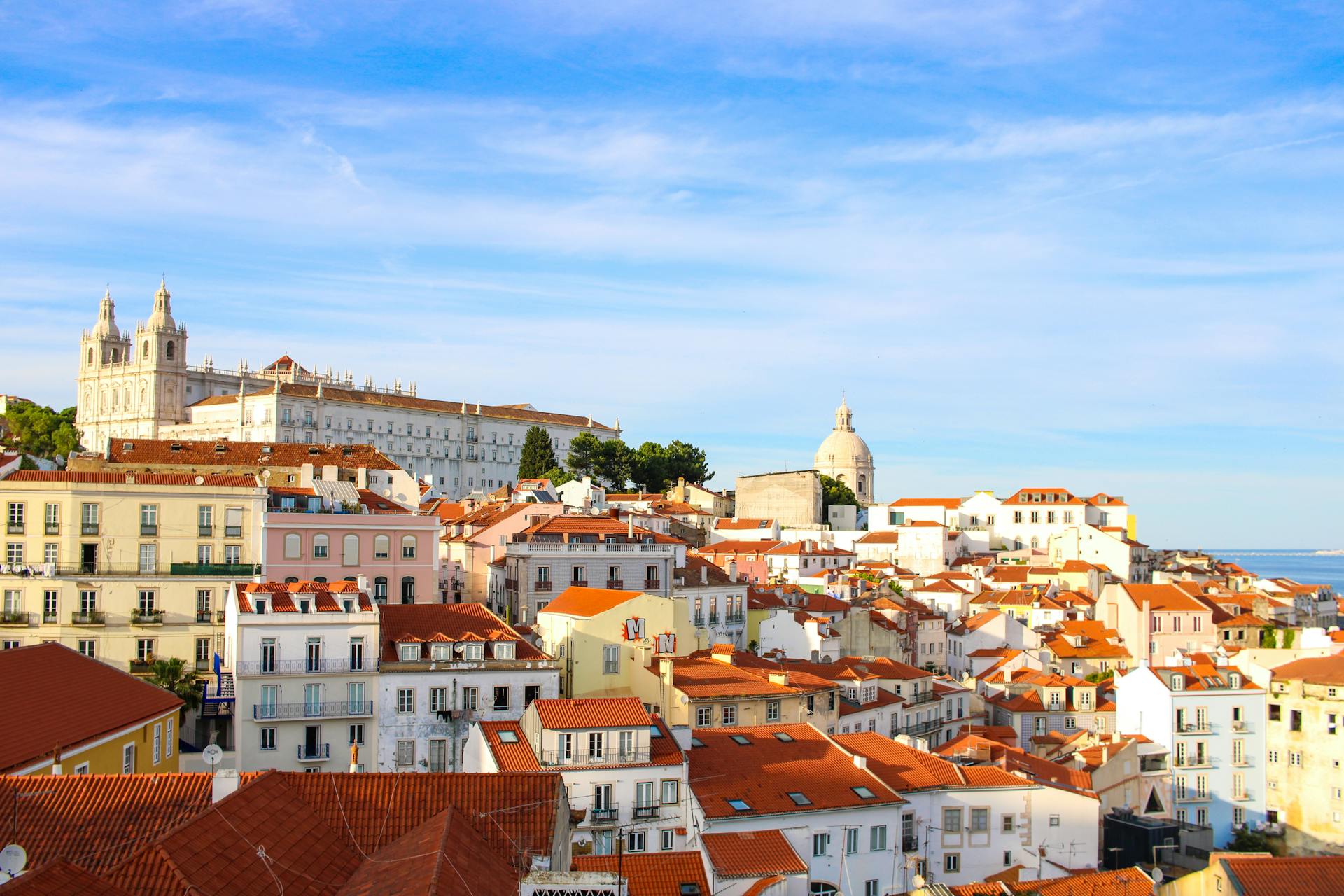
A city of hills, azulejo tiles and yellow trams, and that train leaves the centre every twenty minutes.
People come to Lisbon for the job. They stay for February: on a winter afternoon, while your friends back north are leaving the office in the dark, you are having a coffee outside in the sun, honestly wondering why you waited so long.
You need neither a car nor a whole weekend to see the Atlantic, and there are waves all year round. Here is what sits at the end of the line, from the spot where you learn to the one where the championships are run.
The Cascais line leaves Cais do Sodré every 20 minutes. More than a kilometre of sand, the largest beach between Lisbon and Cascais, and surf schools right on it. This is where you take your first lesson.
The other side of the bridge, and kilometres of unbroken beach. Bars with their feet in the sand and DJs in the middle, waves and surf schools to the north, and near empty stretches as soon as you head south.
The end of the line. A seaside town with its marina, its lanes and its terraces, and the Sintra-Cascais natural park starting right behind it.
The first World Surfing Reserve in Europe, named in 2011, when only one other existed on the planet. Ribeira d'Ilhas and Coxos. You leave on Saturday morning and you are back in Lisbon for dinner.
Portugal sits regularly in the leading group of the Global Peace Index, well ahead of France and Belgium.
Appointments at a health centre are free. You are covered from the day you start working on a Portuguese contract.
Portugal is one of the countries in southern Europe where English is most widely spoken. You have time to learn Portuguese, and nobody is watching the clock.
Lisbon has one of the biggest expat populations in Europe. You will not have to choose between your friends here and your friends back home.
In July, Lisbon is only a degree and a half warmer than Paris. January is where it all happens: an average high of 14.9°C, against 6.3°C in Brussels and 3.2°C in Berlin. A Lisbon winter is a northern spring that lasts four months. And there are 56 fewer rainy days a year than in Brussels.
| Sunshine a year | Rainy days | January, average high | July, average high | |
|---|---|---|---|---|
| Lisbon | 2,810 hrs | 75 days | 14.9°C | 27.8°C |
| Paris | 1,660 hrs | 110 days | 7.6°C | 26.3°C |
| Brussels | 1,605 hrs | 131 days | 6.3°C | 23.5°C |
| Amsterdam | 1,780 hrs | 133 days | 6.2°C | 22.5°C |
| Berlin | 1,730 hrs | 101 days | 3.2°C | 25.0°C |
And the sea climbs to 20.5°C in August and holds there through September.
The airport is three metro stops from Parque das Nações. Going home to see family fits inside a weekend.
Real prices, not the ones on the tourist streets.
The price of the transport pass has not gone up in seven years. And it is free up to the age of 23 once your residence is registered.
It depends on the role, the language and the employer, and a good share of our roles also come with help towards accommodation and the cost of getting there. Your recruiter gives you the exact detail, package included, before you commit to anything.
The price shown is the asking rent per square metre in that neighbourhood, in April 2026. The city average is €22 per square metre: anything below is a good deal.
Built for Expo 98: recent buildings with lifts, a riverfront and wide avenues. Northern European comfort without the shock of old housing stock, and below the city average even though it reads as upmarket. Plenty of head offices and service centres on the doorstep.
🚇 Red line · 3 stops from the airportThe most cosmopolitan part of the city: dense, full of everyday shops, and without a single monument, which means without a single stream of tourists. Everything gets done on foot or by metro.
🚇 Green line · 5 stops from Baixa-ChiadoPlanned in the 1940s, with a regular street grid, a municipal market and green space. People who move in tend to stay. This is the neighbourhood of those who do not go home after a year.
🚇 Green line · 9 stops from the centreThe cheapest of the neighbourhoods that are genuinely lived in and properly served. No postcard, but a real neighbourhood, a real metro line, and several hundred euros saved every month.
🚇 Blue lineA grid laid out on a plateau, handsome buildings from the late 19th century, a converted market hall and independent shopkeepers. The nicest part of the city to live in, as long as you accept that there is no metro.
🚇 Trams 25E and 28E · no metroWorth avoiding when you first arrive: Alfama, Baixa, Bairro Alto and Avenida da Liberdade. These are the most expensive areas in Lisbon, and the ones losing residents fastest. You pay top price to live inside a piece of scenery.
Cabo da Roca, 42 kilometres from the centre, is the westernmost point of mainland Europe and of the whole Eurasian landmass. It is literally the end of the world, an hour from your front door.
Ericeira, 45 minutes away by bus, was named the first World Surfing Reserve in Europe in 2011. Only one other existed on the planet before it.
The public transport network includes four listed funiculars and lifts, which exist only because the city is built on seven hills. Your legs will remember the first month.
Salary shown upfront, a signed job offer before you fly, and the local language is never required.
Fifteen minutes on the phone with a recruiter who lives there. We go through the open roles, the package and the timing.
Hiring multilingual talent? We cover the European markets. ★ 5.0 · 132 Google reviews What we do for you →
Measurement and attribution
With your consent, we keep for 90 days a record of the campaign that brought you here, so we know what works. Our audience measurement is anonymous and needs no consent. You can change your choice at any time. Privacy policy