← All our cities🇪🇸 Spain
Living in Málaga
The city where expats say they are made to feel most at home in the world.
The city where expats say they are made to feel most at home in the world.
Málaga has changed character in fifteen years. The Costa del Sol city has become a city of offices and campuses: the local technology park holds seven hundred and fifteen companies and close to twenty-eight thousand employees, and Google runs there what it describes itself as its main European cybersecurity centre.
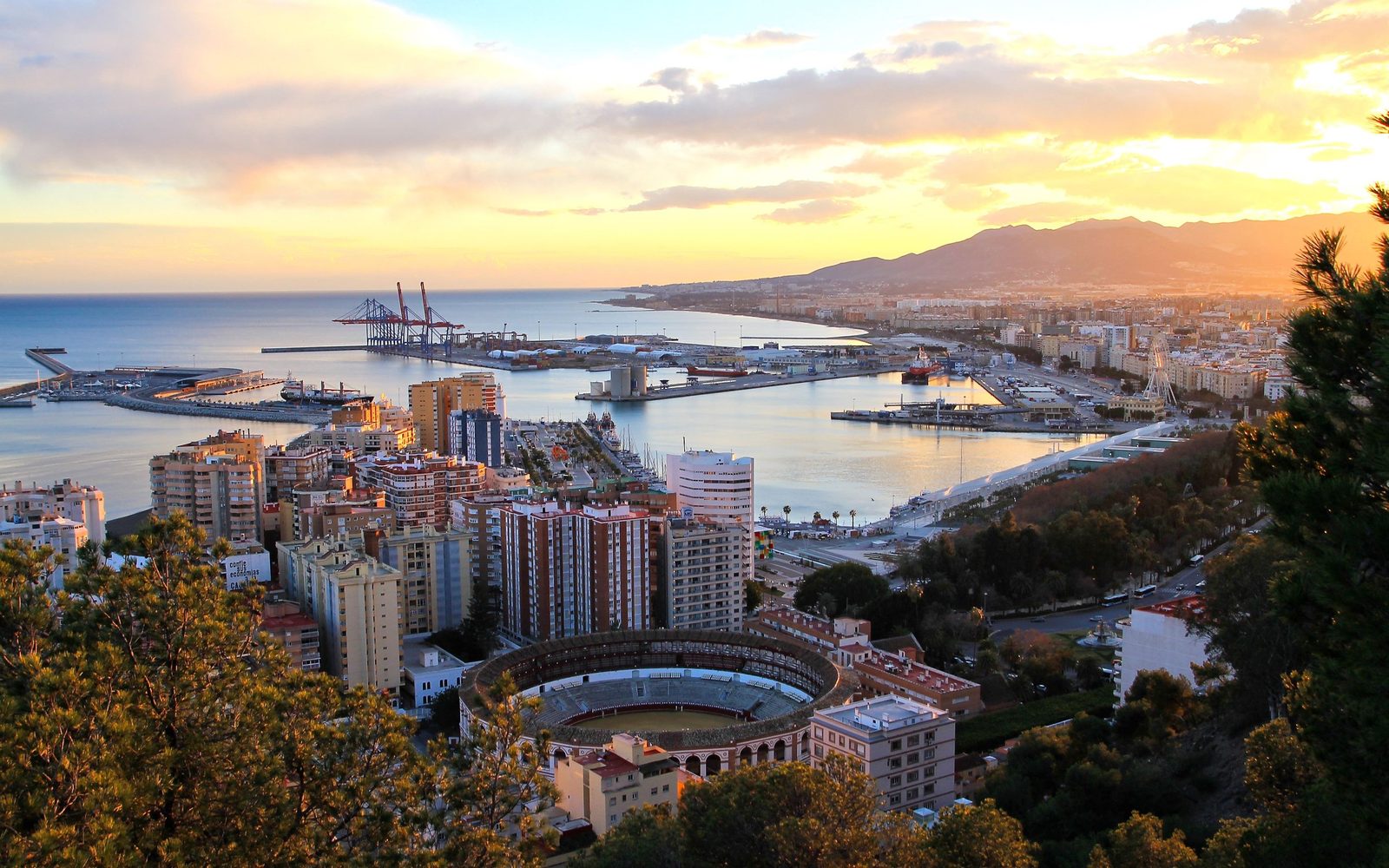
The rest is geography. Fourteen kilometres of beach inside the city, a metro that has served the centre since 2023, a railway station inside the airport terminal twelve minutes away, and the sierra starting the moment you turn your back on the sea.
Fourteen kilometres of city beaches, a train leaving every twenty minutes for the western coast, and, the moment you turn your back on the sea, gorges, a UNESCO-listed karst and a national park created in 2021.
The closest beach to the historic centre, at the end of Muelle Uno. Twelve hundred metres of sand, chiringuitos open all year, and the smell of espetos.
Line C-1 leaves the centre every twenty minutes and runs thirty-one kilometres along the coast. Torremolinos at twenty-two minutes, Benalmádena at thirty, Fuengirola at forty-six. Twelve Blue Flag beaches along the way.
Two point nine kilometres of walkways bolted to the cliff, in places barely a metre wide, up to a hundred and five metres above the river. Built between 1901 and 1905 for the workers of a hydroelectric plant, restored for nine million euros and reopened in late March 2015. Booking required.
One thousand one hundred and seventy-one hectares of limestone carved by water, protected as early as 1929 and inscribed by UNESCO in 2016. Three marked trails, from one and a half to three and a half kilometres.
InterNations Expat City Ranking, fifty-three cities scored by expats themselves: Málaga is second overall, and first in the world both for ease of settling in and for feeling at home.
VirusTotal was born in Málaga in 2004 and bought by Google in 2012. The VirusTotal, Mandiant and Google Security Operations teams now work on the same site.
Close to twenty-eight thousand employees and over four billion euros of turnover. Since 1995 it has hosted the world headquarters of the international association of science parks.
In the European survey on quality of life across eighty-three cities, Málaga ranks fifteenth on this measure, twenty points ahead of Berlin and Brussels.
Málaga has 2,905 hours of sunshine a year, against 1,660 in Paris and 1,605 in Brussels. But the number that lands hardest is January: an average high of 16.8 °C, nine degrees more than Paris and ten more than Brussels on the same date. Ninety-nine per cent of expats surveyed in Málaga say they are happy with the climate, against fifty-eight per cent worldwide.
| Sunshine a year | Rainy days | January, average high | July, average high | |
|---|---|---|---|---|
| Málaga | 2,905 h | 42 d | 16.8 °C | 30.5 °C |
| Amsterdam | 1,780 h | 133 d | 6.2 °C | 22.5 °C |
| Berlin | 1,730 h | 101 d | 3.2 °C | 25.0 °C |
| Brussels | 1,605 h | 131 d | 6.3 °C | 23.5 °C |
| Paris | 1,660 h | 110 d | 7.6 °C | 26.3 °C |
The sea reaches 24.3 °C in August and holds above twenty-two degrees from July to September.
Málaga has a railway station inside terminal 3: twelve minutes to the centre, eight to the high-speed rail station, a departure every twenty minutes. Fifty-two airlines serve the airport.
Frequencies recorded in July 2026, outbound only.
Real prices, not the ones on the tourist streets.
Under-14s travel free on the urban network throughout 2026, and the Consorcio card gives free unlimited transfers for one hour on the bus network.
It depends on the role, the language and the employer, and a good share of our roles also come with help towards accommodation and the cost of getting there. Your recruiter gives you the exact detail, package included, before you commit to anything.
The price shown is the asking rent per square metre, recorded in April and May 2026. The city average is €16.3 per square metre, and a room in a flatshare runs around €437. In Málaga, flatsharing is not a fallback: it is the normal way to live when you arrive, and it is what makes the city affordable.
The university district, built up in the 1990s around the campus. 2000s buildings, so lifts, insulation and parking, with 90 to 105 square metre flats that share well. Six metro stations in the district. The trade-off: no beach, no historic centre, and a tight market in September because of the students.
🚇 Metro L1 · 14 min from AtarazanasThe first planned working-class district in Málaga, created in 1868 by an industrialist who wanted families out of the overcrowded corralones: over a thousand individual homes in small blocks. The maritime identity is intact, calle Tomás Echeverría holds the bars, and the district borders three beaches including La Misericordia, the longest in the city.
🚇 Metro L2 · 12 min from AtarazanasTwenty hectares regenerated on the initiative of residents and shopkeepers in the late 2000s, now an open-air street art gallery with murals by Shepard Fairey, ROA and D*Face. The contemporary art centre and the theatre are here. One euro seventy cheaper per square metre than the historic centre, and one of the few central districts gaining residents.
🚇 Between the port and the Parque · on footA former fishing village turned district, with a strong identity, a seafront promenade and chiringuitos open all year. It is the only seafront address in Málaga where rents are falling. There is no metro to the east: it is served by bus, and seventeen lines cover the district.
🚇 8.7 km from the centre · by busThe cheapest district in Málaga, nearly three euros fifty below the centre per square metre. Residential, quiet, built in the 1970s. The trade-off is real: no beach, no metro, and very few rental listings at any given moment. An effective fallback, as long as you start looking early.
🚇 To the north · no metroThe Centro Histórico and La Malagueta are the two most expensive areas. The historic centre has lost 7 % of its residents in ten years to holiday rentals, and its housing stock is the smallest in the city, often forty to sixty square metres: a poor call for a flatshare, or for anyone working shifts.
A Roman theatre from the first century BC slept under the city until 1951, when it was rediscovered by accident during garden works. Abandoned in the third century, it had served as a fish-salting factory, then as a cemetery. The Moorish alcazaba above it, built in the eleventh century, reused its columns and capitals.
The moscatel raisin system of the Axarquía, behind Málaga, is the first European farming system inscribed on the FAO register of globally important agricultural heritage, declared in Rome on 19 April 2018.
The espeto is cooked on a boat filled with sand set on trestles: the sardines are threaded onto fifty-centimetre canes and grilled twenty centimetres from olive-wood embers, for six minutes. A UNESCO application was filed in 2017.
Salary shown upfront, a signed job offer before you fly, and the local language is never required.
Fifteen minutes on the phone with a recruiter who lives there. We go through the open roles, the package and the timing.
Hiring multilingual talent? We cover the European markets. ★ 5.0 · 132 Google reviews What we do for you →
Measurement and attribution
With your consent, we keep for 90 days a record of the campaign that brought you here, so we know what works. Our audience measurement is anonymous and needs no consent. You can change your choice at any time. Privacy policy