← All our cities🇬🇷 Greece
Living in Thessaloniki
The second city of Greece, a brand-new metro, and Halkidiki forty-five minutes away.
The second city of Greece, a brand-new metro, and Halkidiki forty-five minutes away.
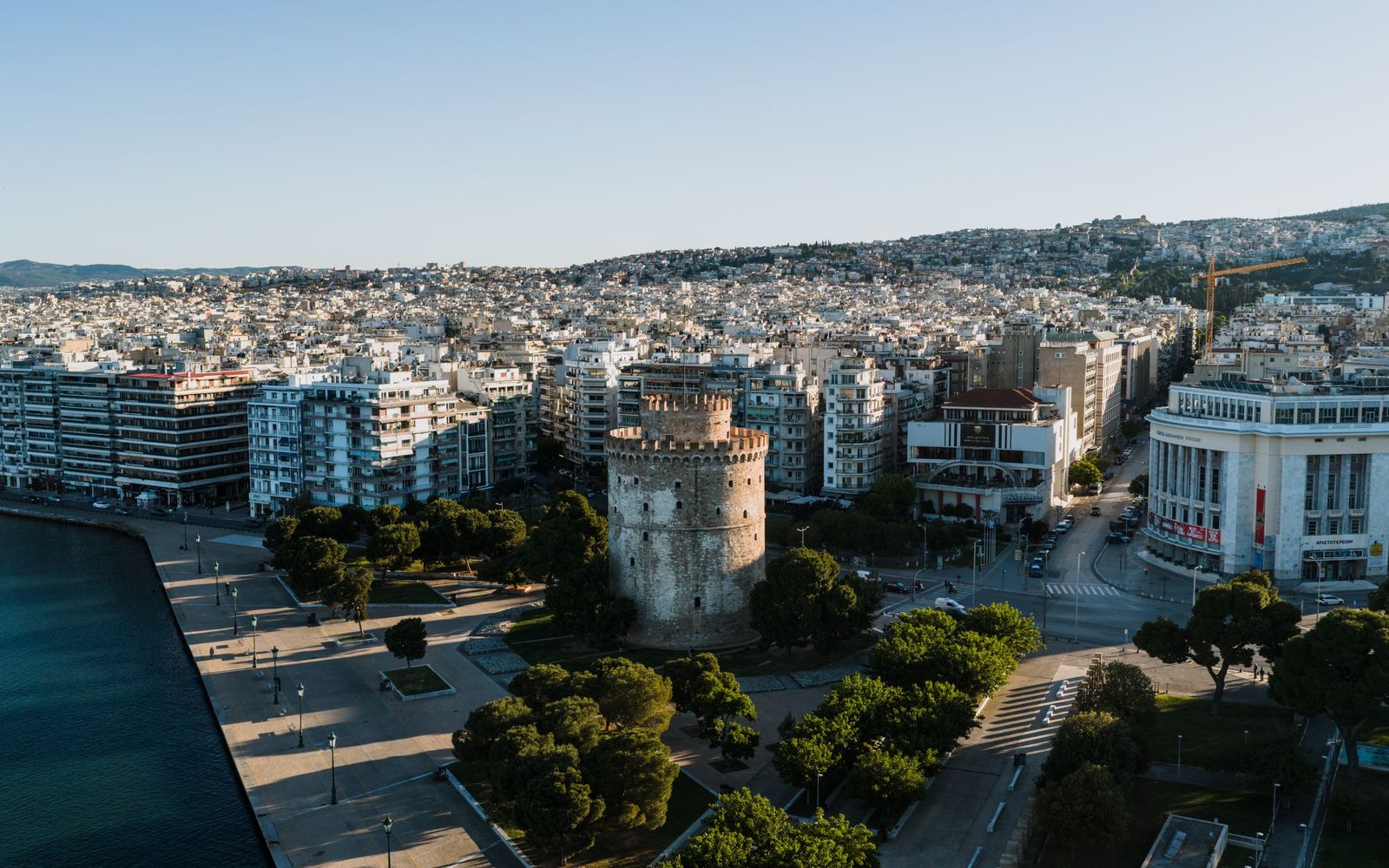
Thessaloniki is not a smaller Athens. It is a student city on the sea, built around eighty-eight thousand students, with a redesigned waterfront people run along in the evening and a coffee culture that borders on discipline.
It has just been given its metro after thirty-eight years of works, and the monthly metro pass costs sixteen euros. Halkidiki and its three peninsulas are less than an hour away by road.
Halkidiki starts forty-five minutes away by car, and Mount Olympus is an hour and a half. It is the best-placed Greek city for weekends.
The closest and best equipped peninsula: organised beaches, seafront tavernas, resort villages. KTEL buses from the coach station if you have no car.
Wilder, more beautiful, harder to reach. Coves you get to down dirt tracks and water that justifies the drive. A car is necessary here, the beaches are too scattered.
Two thousand nine hundred and seventeen metres. From Litochoro you walk up to the refuge in a day. KTEL buses roughly every hour from Thessaloniki.
The royal tombs of Philip II, UNESCO listed, and the city where Alexander the Great was born. Pella is forty minutes away: the shortest day trip of all our destinations.
Opened on 30 November 2024 after thirty-eight years of works. Thirteen stations, eighteen minutes end to end, driverless. Venizelou station keeps seventy-seven metres of the marble-paved Roman avenue, in place.
Three peninsulas, hundreds of beaches, and the first one forty-five minutes down the road. You finish at five, you are in the water at six.
Aristotle University is the largest in Greece, spread over thirty-three hectares in the middle of town. That is what gives Thessaloniki its average age and its opening hours.
Two thousand nine hundred and seventeen metres, the highest point in Greece, reachable by bus from the coach station. You walk up to the refuge in a day.
Thessaloniki is further north than Athens and you feel it: winter is more pronounced than on the southern coasts, with highs around eleven degrees in January in the centre. Summer, on the other hand, is heavy: an average high of thirty-two degrees in July, and a sea at twenty-six degrees in August that stays swimmable into October.
| Sunshine a year | Rainy days | January, average high | July, average high | |
|---|---|---|---|---|
| Thessaloniki | 2,337 h | 117 d | 11.1 °C | 32.2 °C |
| Paris | 1,660 h | 110 d | 7.6 °C | 26.3 °C |
| Brussels | 1,605 h | 131 d | 6.3 °C | 23.5 °C |
| Amsterdam | 1,780 h | 133 d | 6.2 °C | 22.5 °C |
| Berlin | 1,730 h | 101 d | 3.2 °C | 25.0 °C |
January temperatures differ by two degrees between the airport and the city centre: that is the urban heat island, and the centre is where you will live.
Makedonia airport is fifteen kilometres from the centre, served by a two-euro bus that runs around the clock. Eight million passengers in 2025, ninety-seven destinations.
Said plainly: many of these routes are seasonal and infrequent, two to three flights a week to Paris, Geneva and Brussels. Thessaloniki is less well connected than Athens, and the offer thins out in winter.
Real prices, not the ones on the tourist streets.
The freddo espresso is the cheapest in Greece here, at two euros fifty against two euros ninety in Athens. The souvlaki, on the other hand, is the most expensive on the Greek mainland: four euros ninety.
It depends on the role, the language and the employer, and a good share of our roles also come with help towards accommodation and the cost of getting there. Your recruiter gives you the exact detail, package included, before you commit to anything.
The average asking rent in the municipality of Thessaloniki is €10.44 per square metre, against €7.83 in the surrounding municipalities. The prices below are from 2025 and 2026.
Everything is walkable and everything stays open late, with Aristotle University ten minutes away. The other side of it is noise, nineteen-sixties blocks with no insulation, and student demand that forces you to look early.
🚇 Three metro stations in the districtThe only district spared by the 1917 fire: cobbled lanes, wooden Ottoman houses, Byzantine walls and a view straight down over the gulf. No metro and a real slope, so it suits committed walkers.
🚇 15 to 25 min on foot, downhillA dense working-class district with local shops, tavernas, neighbourhood bars and the PAOK stadium. The same budget buys you more square metres, and the metro serves it directly.
🚇 Direct metro · Voulgari, Efkleidis, PapafiA marina, a seafront promenade, parks and terraces. Buildings are newer and better built than in the centre. The metro extension reaches it, though it had not opened yet this summer.
🚇 25 to 30 min by busThe metro took thirty-eight years to build, mostly because of archaeology: more than three hundred thousand objects were excavated across seven stations, at a cost of a hundred and thirty-three million euros. The tunnels were dug between fourteen and thirty-one metres down to preserve what lay above.
At the end of the nineteenth century the Sephardic Jewish community made up roughly half the city, which was known as the Mother of Israel. Ninety-six per cent of that community was murdered after March 1943.
In February 2017 the defusing of a 1944 bomb found at a petrol station forced seventy thousand residents to evacuate. The army was never able to establish whether it was German or Allied.
Fifteen minutes on the phone with a recruiter who lives there. We go through the open roles, the package and the timing.
Hiring multilingual talent? We cover the European markets. ★ 5.0 · 132 Google reviews What we do for you →
Measurement and attribution
With your consent, we keep for 90 days a record of the campaign that brought you here, so we know what works. Our audience measurement is anonymous and needs no consent. You can change your choice at any time. Privacy policy